
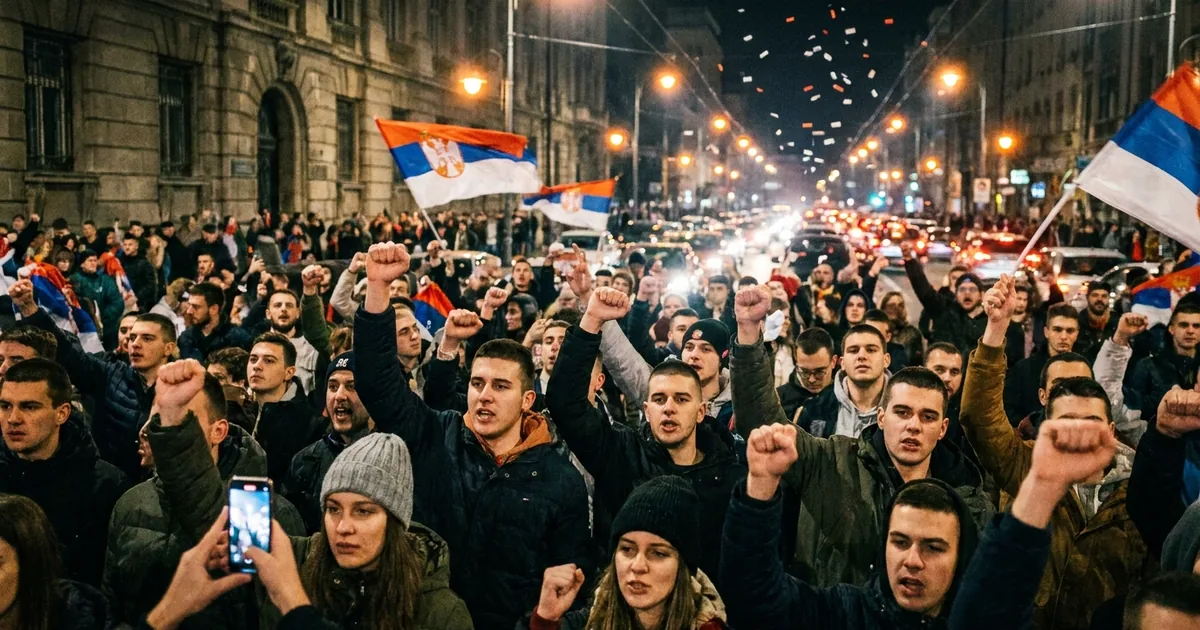
Aleksandar Vučić gave up the presidency of Serbia four weeks ago so he could run for prime minister, and on Sunday night he admitted he had lost that race too. Based on a stratified sample of the count, he said, “it is clear that we have lost these elections. The Student List has won.” He now holds neither office, which is the part the early coverage is skating past: the man whose party has run Serbia for 14 years bet the whole thing on one vote and the voters took the bet.
The numbers he gave put the student-led list at 135 to 140 seats in the 250-seat National Assembly and his Serbian Progressive Party at about 105. A majority takes 126. Add his figures together and they account for 240 to 245 seats, which leaves five to ten for the ethnic-minority lists that clear a lower threshold. BTA reported roughly 2.2 million votes for the student list against about 1.72 million for the Progressives. By our arithmetic that is a 56 percent share of the vote between the two, from a movement that did not exist as a party two years ago.
A Wager He Made Himself
Vučić did not have to be on this ballot. The election was not due until late 2027, and his presidential term had seven months left when he resigned on September 27. The point was to let him lead the Progressive list as its candidate for prime minister, a way to keep power after his term ended. Parliament’s speaker, Ana Brnabić, became interim president, and a presidential vote has to be completed within 90 days, which puts a first round before the end of December.
That sequence is now the story. He called the early election, led the Progressive campaign himself, and walked out of the one office he was guaranteed until spring. Whatever else Sunday means, it was a decision he made and lost.
What Two Years of Protest Bought
The students did not start as a political party. The movement grew out of the November 2024 collapse of a railway station canopy in Novi Sad that killed 16 people. Protesters blamed corruption and a state where nobody answers for failures. Marches turned into blockades, blockades into near-permanent mobilization, and the demand never really changed: accountability, the rule of law, an end to corruption. The Student List campaigned on those, with academics, teachers and other first-time candidates, and little else.
Turnout was nearly 70 percent, the highest since Yugoslavia broke apart in 1992. That number matters more than the seat count. Governments like this one survive on demobilized voters, on the sense that nothing changes so why bother. An electorate this large and this angry is what that machine was built to prevent. When the result was announced, the streets of Belgrade filled with horns and chants of “victory” and “he’s done.”
What We Do Not Know Yet
Be careful with the word “concede.” Vučić said he did not have final results, and the seat range is his own reading of a sample, not a count from Serbia’s electoral commission. A party that has controlled the state, the broadcasters and the civil service since 2012 does not stop being powerful because its leader gave a speech. Brnabić, who came up through his party, is the interim president, and the presidential race is still ahead. The transfer of the cabinet, the prosecutors and the police is where a concession becomes real or turns out to be a pause.
The students also arrive with questions of their own. They have avoided detailed commitments on EU membership, floated a referendum on it within six months of taking office, and signaled continuity in relations with Moscow. A government elected on the rule of law will have to say where it stands between Brussels and Moscow. We think that answer matters, and we will cover it when they give one.
Why Everyone Else Should Pay Attention
We do not usually spend much time on Belgrade, but a result like this is rare enough to stop for. Strongmen do not tend to lose elections they called themselves, to a list of teachers and academics. The working assumption in a lot of capitals has been that Serbia’s government could not be voted out. Sunday night’s result says it can, and that the work that does it looks less like a campaign and more like two years of showing up.
The test now is whether he lets it stand. He said he lost. Serbia is about to find out whether he meant it.