
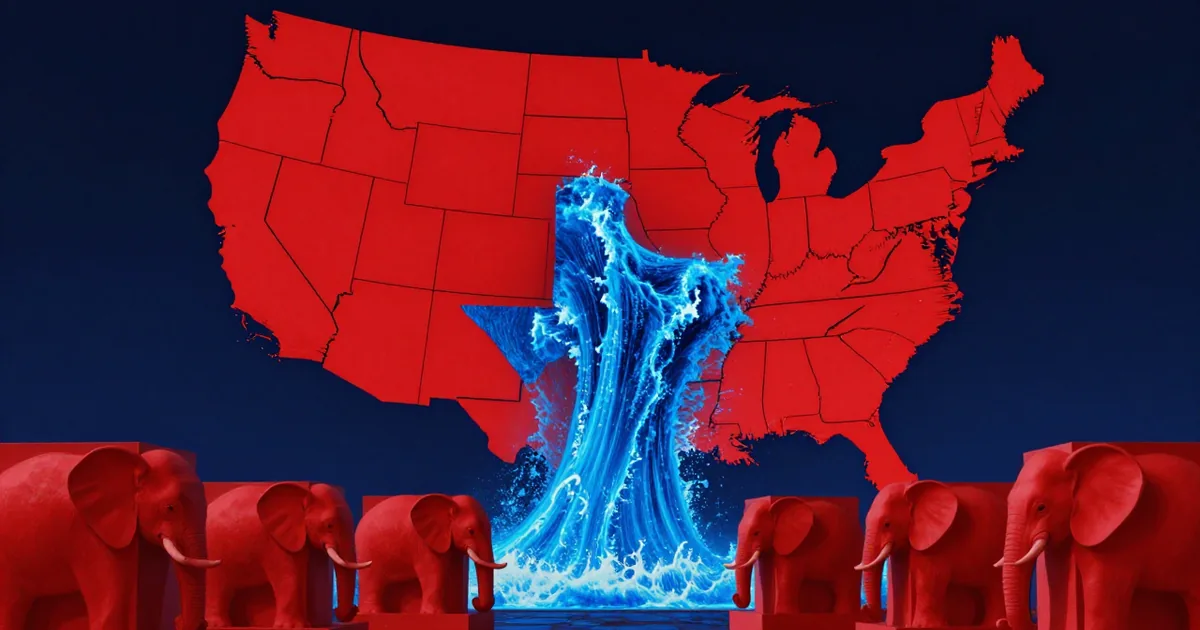
Nate Silver’s forecast now gives Democrats a 76.4 percent chance of winning the Senate and 95 percent in the House, and in a conversation with Ezra Klein released Tuesday he said the vote would mark “the end of the Trump era” if it lands where the polls say. The part the headline odds leave out is the arithmetic that gets Democrats there, and the one scenario in which it all comes apart: a three-point polling miss across the board.
Silver’s case starts with a rule he calls one of the few that survives for decades: the president’s party gets punished at the midterm. The average swing against it is seven and a half points. This year, he said, it looks closer to eleven. That single number does most of the work, because it drags states Trump won comfortably into range. We put his own examples next to the current Silver Bulletin polling averages, which list Texas at D +2.4 and Ohio at D +3.2:
| State | Trump 2024 margin | After an 11-point swing | Silver Bulletin average now |
|---|---|---|---|
| Texas | R +13 | R +2 | D +2.4 |
| Ohio | R +11 | Tossup | D +3.2 |
Texas is the tell. The swing alone leaves Republicans ahead by two, so the roughly four-point gap between that and the polls is the price of nominating Ken Paxton, which Silver put in plain terms: the question is whether Paxton is below average enough to turn R +2 into D +2. Candidate quality, he said, moves a race by five points at most. The House looks different from the Senate. Silver said the model’s average Democratic gain is about 22 seats, not a 1994-style rout, because redistricting and self-sorting have left so few swing districts.
What a Three-Point Miss Does
Silver was blunt about the risk. Ask of every Senate poll, he said, what happens if they are all off by three or four points in the same direction. Democrats hold many three-point leads, so a three-point error would mean “a very long night.” Maine is the one Democrats should watch: Susan Collins beat her final polls by roughly nine points last time. And if Democrats somehow lost the House, he said, the questions about polling would be profound.
Here is where we land. The Republican problem is not a mystery pollsters missed; it is a president who decided to go to war with Iran and push gas prices toward the mid-$4s, in Silver’s account of what changed the Senate map. Trump’s one electoral trick is dragging disengaged voters to the polls when he is on the ballot, and he is not. Klein pointed out that Trump could have cleared Cornyn’s path in the Texas primary and chose not to. A party that lets its president pick its weakest candidate in its most expensive state has earned a bad November.
Whether it is a wipeout depends on turnout among low-propensity voters, who Silver says are leaning Democratic in early voting. Republicans have until Election Day to catch up.