
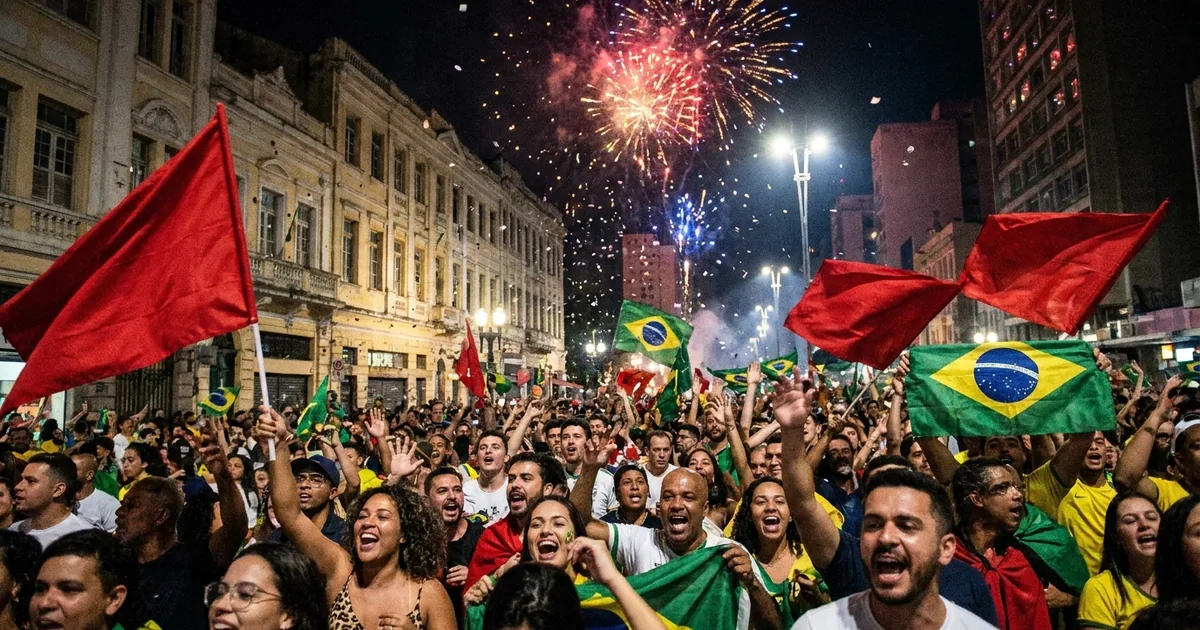
The expectation: Flávio Bolsonaro finished the first round on 4 October ahead of Lula, 47.03% to 45.16%, and Brazil’s right had the momentum.
The count: three weeks later Lula won the runoff 51.8% to 48.2%, a margin of roughly 4.3 million votes.
Luiz Inácio Lula da Silva has won a fourth term as president of Brazil, and the number to hold onto is not his 51.8%. It is the swing: Bolsonaro led the first round by about 2.2 million votes, and Lula won the runoff by about 4.3 million. By our arithmetic that is a 6.5 million vote turnaround in the gap between the two men in 21 days. The first-round figure counts a wider field and the runoff is a two-man race, so treat it as a measure of momentum rather than a like-for-like comparison. It is still the size of the thing.
The Superior Electoral Court put the final split at 51.8% to 48.2% of valid votes. No candidate since the return of democracy had lost the first round and then won the presidency in the runoff, and Lula, who turns 81 on Tuesday, just did.
The night did not look like a comeback for a long time. Bolsonaro led the early count, touching 50.3% with barely a third of the sections reported. Then the Northeast’s results came in and reversed the race: by the time 70.55% was counted Lula was ahead 50.92% to 49.08%, and he never gave the lead back.
What nearly turned into the real story was the clock. Supreme Court Justice Cristiano Zanin, who was Lula’s lawyer before he was a justice, ordered voting extended by two hours, and he did it three minutes before the 5 p.m. close. Some polling places had already shut and some machines could not be restarted. That is a mess, and the biography of the man who signed the order is a gift to anyone looking for a grievance.
Here is the part that matters, and it is the part that gets lost when the biography does the talking. Both campaigns asked for the extension. Lula’s team cited transport problems in nine states; Bolsonaro’s cited heavy rain in the south. A nationwide extension that both sides requested, applied to every voter in the country, is a very strange instrument to fix a 4.3 million vote result onto one candidate. Al Jazeera reported that legal challenges are likely, and none of the accounts we read carried a concession from Flávio Bolsonaro. We think that if a challenge comes, it should be filed with evidence of a stolen margin, and nobody has produced one.
Brazil has seen this movie. In 2022 Jair Bolsonaro stayed silent for two days after losing to Lula. His son now has the chance to do what his father would not, and it costs one sentence: say the words.
Now the leverage, because Lula won an election and did not win a country. Bolsonaro’s Liberal Party made the biggest gains of any party, which hands Lula the most right-wing Congress of Brazil’s democratic era. More than 48% of voters picked the other man. He takes office in January with a legislature whose largest bench belongs to his opponents and a public debt he is expected to stabilize. His promise of “a new way of governing” came with no description of what that means, and the first test arrives when the budget meets that bench.
The foreign counterparty is Washington. Trump did not formally endorse Flávio Bolsonaro the way he did the candidates who won in Colombia and Honduras, but the BBC says there is little doubt the White House wanted a conservative in Brasília, and Trump called the first-round result a “big victory” for Flávio. Argentina, Chile and Colombia now have conservative presidents. Brazil, with 213 million people, the world’s second-largest reserves of rare earths and a president who warned Washington that Brazil would “never fit into anyone’s backyard,” is the one large South American holdout, and the voters just kept it that way. Lula told supporters the country “needs peace and unity,” which is easy to say on the night and hard to deliver against a Congress that would rather he fail.
So here is where we land. Lula’s win is a real defeat for the project of lining up the continent behind Washington, and the size of it removes the excuse that would have been offered if it had been close. The ugliest outcome now is not a Lula term of gridlock. It is a loser who treats a two-hour extension that his own campaign requested as a reason not to say the word “won.”